Saturday, May 1, 2010

There's More to It Than Racing?


After I get back from a show each weekend, the most common question I am asked is: “So how did your race go?” Due to the widely broadcasted event called the Kentucky Derby, non-equestrians seem to think that racing is the only form of horseback riding. While the term “horseback riding” is the main generalization of the sport, there are a number of different forms of riding that make up the whole activity.

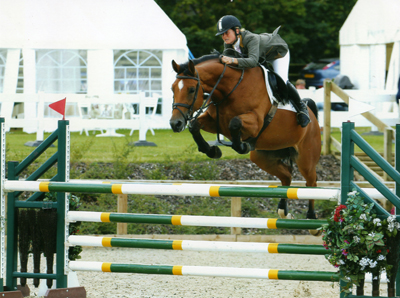
Along with racing, the other commonly known type of riding is polo, not the clothing brand, but the game Prince William is often featured playing. These two are the most popular, but there are other divisions such as English, western, eventing, gymnastics, dressage, cross country, and many more. I participate in English, which consists of jumping and equitation, both judged on the form, cooperation, and most importantly, the skills of both the rider and horse. While there are many types of riding and riders, each participant requires a different amount of skill to become successful in their sport.

These skills may appear to be random or unimportant in daily life but they are highly valuable to each equestrian. These skills vary through many different aspects of the riding. For example, jumpers need to have great depth perception in order to judge the distance between themselves and the fence, while western riders require the balance to stay upright while racing around a barrel. Without these vitally important skills, each equestrian would be unsuccessful in their riding. Each type of riding is different and requires its own amount of skill, though the one requirement that they all have in common is the need for communication.
It Began With A Birthday

Everybody is born with a passion in their hearts. I was born with a love for horses and everything equine. My parents surprised my friends and I with pony rides for my sixth birthday and that’s when my love became my passion. Naturally, I began begging for riding lessons, which they granted me about the time I was ten. Horseback riding quickly took over nearly every aspect of my life. Weekday afternoons were spent with riding lessons and weekends were consumed by traveling to competitions or just hanging out at the barn.

After devoting nearly my whole life thus far to being an equestrian, it’s insulting to take note of the lack of recognition that the sport receives in our society. Half of the reason is that people don’t understand all the effort equestrians put into our sport. The other half is under the impression that horseback riding consists of riding ponies around in circles while looking pretty.

Horseback riding is a different kind of sport due its unique requirements and forms of competition, but it is still a sport nonetheless. Sports consist of: skill, strength, communication, teamwork, determination, and hard work, all of which is demanded of the equestrian sport. Due to these requirements, horseback riding should be recognized more as a sport, and not as a hobby between girls and their ponies.

Thursday, April 15, 2010

It's a bunch of different things

When non-equestrians think of horseback riding, they tend to jump to horse racing which is the most familiar thing to them. They think of the Kentucky Derby, with little jockeys clinging to the backs of galloping horses. WHile racing is a big deal in the equestrian world, it's only a small category that makes up the bigger generalization. Horseback riding is a ton of different sports within a sport. Here's a few examples of the different types of riding:


The top is Racing, the middle is Show Jumping, which is what I personally participate in, and the bottom is Polo. Though these are just a few examples,and the list goes on and on. Theres: Equitation, Western, Cross Country, Fox Hunting, Hunters, Gymnastics, and many many more. Every single type of riding requires it's own need for athleticism and skill.

Friday, April 9, 2010

Olympic Riders

I found an e-book on the Berry Library site called "A Who's Who of Sports Champions: Their Stories and Records". It has the short biography of different sports champions including a couple riders that participated in the Equestrian part of the Olympics. One of the riders is Bill Steinkraus who rode for six U.S. Olympic Teams and was the captain of 5 of them. He also was the first American to win the gold in indicidual jumping. I find it a great success that Steinkraus is mentioned in this book and that Equestrian Athletes are starting to be recognized as some of the champions of our time.

Tuesday, April 6, 2010

It's All About Communication or "Plays"

During sports, the teammates have to communicate back and forth to make sure everything runs smoothly. This is done through yelling to each other or relaying plays from the coach. During horseback riding we have our own "plays" or ways of communication with our teammate. A slight complication would be if the team spoke different languages. Or if the team couldn't speak at all. This is how it works in horseback riding. We have different ways to communicate with each teammate.

With horses, every single one has a different way of communication from the rider. Whether it's preference or simply the way they were trained. For example I use the differences between my two horses. With my horse John John, to ask him to move forward you squeeze with your calves, sit back, and pull slightly back on the reins. With my other horse Sassie, you squeeze with your calves, lean forward, and loosen the reins. So every time you get a new teammate, your "plays" or forms of communication will change.

This typically doesn't happen with other sports. Every team will come up with it's own set of plays but they don't normally change with every practice or game. That's why horseback riding is a little different.

Thursday, March 25, 2010

British Journal of Sports Medicine

On Galileo, I found this journal from the British Journal of Sports Medicine. I liked this one and added it to the blog because it gives calculated statistics of the usual injuries acquired from horseback riding and equestrian related activities. My last blog post was about equestrian related injuries so I felt like some statistics would help give some accuracy.

Tuesday, March 23, 2010

Equestrian Olympics

Many people don't consider horseback riding to be an actual sport a much as a hobby or pastime. But these same people also don't realized that equestrian sports such as 3-day eventing are held during the Olympics every year. This article from Sports&Fitness magazine describes the history of the Equestrian Olympics.

The Equestrian section of the Olympics is brutal, exhilarating, and astonishing all at the same time. I have had friends watch the Equestrian games with me and stare at the screen in amazement. What these horses and riders accomplish together is a true picture of nerve, bravery, and partnership.